
More Weight
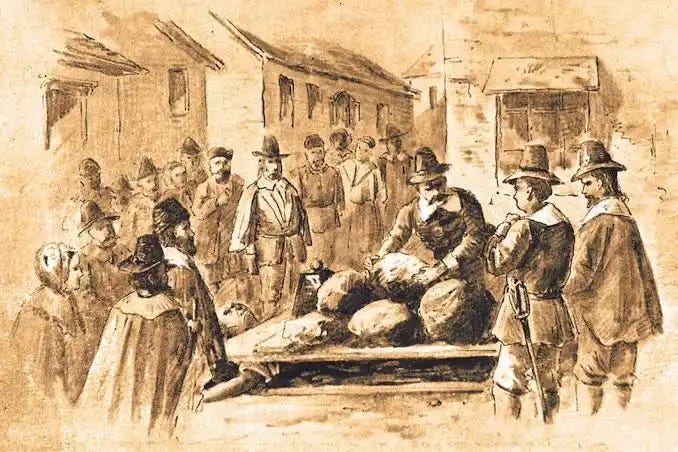
In Praise of Giles Corey, who accused of witchcraft and tortured with heavy stones, said only, "More Weight"

Shallow men believe in luck or in circumstance. Strong men believe in cause and effect.
God will not have his work made manifest by cowards.
— Ralph Waldo Emerson
When the levee bank overflow the streets, but before the streetcars float like clouds above the Vieux Carré, you may find yourself watching TV in your living room when suddenly the water bursts in through the windows, and so fleeing to the second floor of your home, and then fleeing to the attic as the water continues to rise, and then, by and by, forced up to the rooftop.
And then may a man rowing an inflatable lifeboat come to you, and offer you refuge. And you may stare at the boatsman seriously, with fateful eyes, though forlorn, terrified, and shaking, and you may then look down a long time at the water pooling around your shoes.
You might shake your head, thinking of all the others who might be saved by the boat, and take courage.
You say to him, “The Good Lord will provide. Save who you would save but for me!”
And then, when the water comes at last to take your higher ground, so you are standing on your tiptoes upon the asphalt shingles, a pontoon boat may come to you, and its captain shout out to you over the roar of the waters—as homes and cars float by you like massive frigates— and cry out that they have ample room, come and be saved!
And though your heart is leaden with fear, and your mind is gasping in panic, as a fish being swiftly reeled to the airy world, you maintain your resolve.
“The Good Lord will provide. Find another to save!”
At last, as the moonless night takes you over, fatigue and chill having turned you nearly back into a beast, you may be carried far off into the deep, the roaring waves, where all hope is drained from you, and all that is left in you is the impulse to cling to the flotsam, jetsam yourself, and fading fast…
And then may a floodlight find you, drenching you in so many lumens you are just as blind as you were before, and you may hear over you then a loudspeaker, faintly— for the all-consuming growl of the deep has drowned out even the sound of the chopper blades— a voice from afar, calling to you to grab the ladder, come, and be rescued.
Blinking blind, fading fast, with hardly the strength to hold on, you roll your face upwards to the light and weakly, you wave it away.
“The Good Lord will provide. Save not me.”
And incredulous or unhearing, the helicopter lingers over you for a moment longer, and each moment rends your heart with unbearable pain and sorrow— why test me so!—until at last it gets the message and flies off.
A complicated smile is the last face you make as you sink into the deep. Were you good? Did you do the right thing? Would the God, of charity, of compassion, of sacrifice, be proud of you? Did you do right by him? Did you die his faithful man?
Upon your arrival in the Eternal Pastures, you may be greeted by Him, himself. He may smile at you brightly and welcome you into eternity, and in a flash, you may be soothed and refreshed and renewed and made whole.
But a complicated thought may enter your mind.
“But did I do the right thing, Lord?”
He may blink but smile in compassion.
“You were a good man.”
“But…did I do the right thing?”
And He may smile at you then, with such infinite meaning, that you may take that as your answer. Or you may stare in puzzlement. Or you may stare in shock and realization, turning away to spittle and choke in astonishment, while He stands there, smiling in His Infinite Graciousness, waiting for you to recover.
This story, as it was first told to me, ends with the Lord welcoming the man into heaven, and the man sputtering in confusion to the Lord.
“Lord! I thought you would provide for me!”
And the Lord laughs good-naturedly, shaking his head.
“I sent you a rowboat, a pontoon boat, and a rescue helicopter. What more did you want?”
Here, the difference is that the deity, I imagine, does not feel the need to teach the lesson. There is a simple-hearted naiveté that is pure but mistaken, and there is simply no need to trouble that upon arrival. What difference would it make? It’s heaven after all.
And, to my mind, my hope is that the Lord will not punish such naiveté or hold it against us so long as it is pointed generally in the direction of the Gospel message, or at the very least, does no harm.
And who isn’t in many ways naive? The intercession of Mary has surely worked a saving grace for many of those who have died in an admirable naiveté.
Our Lady of the simple-minded and the confused, pray for us!
I pray that Hell is empty, and I hope it is.
I pray that the doors to heaven are wide, however full of friction and demand is the road up Purgatorio.
Just because God makes providence for the naive and the simple does not, I think, mean He hopes that we remain shallow.
God may praise you in Heaven for your purity despite your admirable naiveté. But I do not call my God the God of the Simple and the Naive.
My God is the God of Advantage and Opportunity, of Cause and Effect, of Progress and Advance, of Courage and Daring.
My God, I think, would agree up-and-down that, when the waters took you, you should indeed have left the seat for a more worthy candidate. Because the worthier candidate— the candidate who lives to survive another A/B test— is the one who gets while the getting’s good.
It is not that God likes us to be stingy. But he certainly does not like us to be slavish, stupid, blind, and not make use of the faculties of intelligence he gave us.
That He may smilingly welcome those who passed away from malnourishment after mismanaging their fasting schedule does not mean He greets them with the same excitement as, say, those who died nobly fighting for the Union.
Or as, say, Jesse William Lazear, who died after deliberately contracting yellow fever to prove that mosquitoes were the vector for its transmission, or Daniel Alcides Carrión García, who died similarly. To the cause, they laid down their lives! They kicked the ball forward! Much was ventured, much was lost, and much was gained!
To such as these, He may even feel a sense of anticipation as they ascend the escalator.
I believe that the God of Man runs a Kindergarten up in heaven where the softer souls may gently graze and not worry too much about the gene pool they left behind. There they often sigh, “Good luck, sometimes. Bad luck, other times.” That’s all that can really be said by them about life on that strange, sad, little planet they left behind.
Beyond, there is a field where the big dawgs run. There go those who did not live by staying clear of the rules, but risked daringly with virtue and vice.
Benjamin Franklin weighs in his mind whether defying the Divine Right of Kings will, even if successful in this world, damn him in the next. Pondering, his tongue pressed into his lip, he shakes his head. I’ll chance it.
And there, in that field, there is no stasis, no single day that is the same, no constancy of an endless vacation. Rather, there is light and rain and mud and blisters and snapped arms and broken ribs and pain and wallowing and fierce growling and brutal competition. But God is there laughter.
And, too, there is horse-riding and steep rocky cliff-faces and mighty waves and brutal labors to be done and hard-won achievements and the opportunity for long-trained technique to find advantage. That which those there called, in life, adventure.
I don't grudge the broken arm a bit...I'm always ready to pay the piper when I've had a good dance; and every now and then I like to drink the wine of life with brandy in it.
— Theodore Roosevelt, in a letter, after breaking his arm horse-back riding
I wager that the nature of God is such that he prefers deeply to run with them there. To dwell among the daring, to revel in their life force, to stand near the fire, and feel the reciprocal awe that comes from seeing his creation in action.
There go those who have impressed the deity with how alive they are: the risks they took, the work they wrought, the iron-will of their own hands poised against all odds, the rules they challenged, the inventions they brought together by long study and their own hands, and the unflinching commitment to confronting reality without being a sucker about it.
What some call concupiscence others call the life spirit, finding its way, slowly but progressively, towards the higher good. And by that same concupiscence great gains have been made against the forces of evil, ignorance, and the dark.
To accept this, however, you may need accept that in some way God was smiling and even delighted when Eve slipped out of her sleepy confines: that the machine He made worked as intended by coming alive and surprising him.
Day 15. Thank you!